
Period Yoga (Yes, the Bloody Kind)
I live in a culture that views periods as an annoying inconvenience through which we must push.
We don’t alter our lives to accommodate our periods; usually, we can’t. We are expected to continue working, exercising, taking care of chores, and generally achieving the same productivity levels as we do the rest of the month.
And that’s regardless of any difficult or painful symptoms we might be experiencing. If we’re cramping, no one cares. If we’re irritable, people make jokes. Sometimes we even make the jokes, because it’s easier than taking a more mindful look at this blood ritual our bodies perform every month.
This culture is harming us in many different ways, which would fill umpteen books and take lifetimes to unpack. Today, I’m talking about how this culture actively harms those of us who menstruate by forcing us to live in ways that are incompatible with our natural cycles… and what we might do to resist.
Matthew Henry
The person who really opened my eyes to this issue was my yoga teacher.
During my early training in hatha yoga, my teacher asked me if I knew the most beneficial way to practice yoga during one’s period.
“No,” I said. “Why?”
“We really shouldn’t do much asana during menstruation,” she told me.
I asked her to elaborate. In more than a decade of practicing yoga, I’d never heard a teacher bring up menstruation.
“Many Western studios don’t teach this,” she said, “because life in the Western world is so fast-paced that people don’t even think about taking time to rest. Everyone needs to rest sometimes, whether you have a period or not. But our period is a time when our bodies must take a break.”
She went on to explain that during one’s period, most asanas (physical postures) should be avoided. She said we can do a little pawanmuktasana or practice some very gentle postures, but beyond that, our practice should mainly consist of pranayama and meditation.
She also introduced me to the idea of apana. From a yogic perspective, understanding apana is crucial to understanding what’s happening in the body during one’s period.
Mike Labrum
Prana & Apana
In the US, where I live, pretty much all yoga practitioners know about prana, which is the vital force that sustains more than just the body: it sustains every level of creation in the cosmos. Prana is referenced frequently during yoga classes, even if it is not generally understood in great depth. It is a word most practitioners recognize and can roughly define.
Apana, on the other hand, is not often mentioned during asana classes at all. Teachers that do talk about apana normally teach pranayama or meditation classes, but these types of yogic classes are less popular in the US than asana classes. If I were a fly on the wall at a mainstream hot yoga class, I would be pleasantly shocked to hear the word “apana” uttered from the teacher’s mouth.
So: what is apana?
Apana actually is a type of prana. It belongs to pancha prana, meaning it is one of the five main forces that operate in the physical body. For the sake of this article, we’ll just focus on the first two forces—sthoola prana and apana—and leave the other three for another time.
Sthoola prana is the first of the five pranas. (It is often called simply “prana” for short). Sthoola prana manifests as upward-moving energy currents in the thoracic region between the diaphragm and the base of the neck. It maintains all activities in the chest region—breathing, blood circulation, etc. Sthoola prana is also responsible for all intake of ideas and impressions.
Right now, the main thing to remember is that sthoola prana is an upward-moving force. It is associated with sun energy. It energizes and motivates us; literally speaking, sthoola prana gets us out of bed in the morning.
Apana is the exact opposite.
Aileen David
Apana is the second of the five major pranas. It operates in the pelvic region, and is responsible for all downward force in the body. As such, apana rules the kidneys, bladder, bowels, and reproductive organs.
The force that allows us to eliminate waste is apana. The force that expels the fetus from the womb is apana. And the force that causes the uterus to shed its lining and bleed each month is apana.
Apana is associated with moon energy. It is heavy and dense. Where sthoola prana motivates us, apana slows us.
During menstruation, apana is the dominant force. Prana is pushing downward to eliminate the shed uterine lining, and the body naturally cools itself in order to rest.
As my yoga teacher explained, it is important not to interrupt or inhibit this natural process. Most asanas should be avoided, but especially asanas where the reproductive organs are turned upside-down or at an upward angle. We should also avoid exercise during this time, and ideally, stressful situations in general.
The consequences of ignoring our menstrual needs are serious. When we do not allow ourselves to rest, we worsen our overall health. We are prone to burnout, anxiety, and depression. We put ourselves at heightened risk for disease. And this is true for all humans, not just those of us who menstruate.
Hans Vivek
How to Rest?
It’s all well and good to say we need to take a break during our periods. But in places like the US, this is often difficult or impossible. So what do we do?
Firstly, we must remember that it’s not our fault we were born into a culture where human health, especially gynecological health, is not prioritized or institutionally supported. But now that we’ve happened to be born here, there are steps we can take as individuals to resist the dominant structures that try to control us—and to care for ourselves in the meantime. (Truly, those two goals are one and the same.)
It begins with a shift in perspective. If each of us changes the way we think about our periods, the effect will ripple out into our actions, which may then proceed to influence others. We can find little ways to honor our own natural processes in whatever ways we’re able.
For instance, during menstruation, we might alter our yoga practice accordingly. We might forgive ourselves for putting a few tasks on the backburner at home. We might reduce our inner monologue that constantly demands productivity, and instead replace it with mantra, or with affirmations.
Not all these ideas are possible for everyone, of course; they are simply examples. Each person might try to find methods that work best for them.
And if you don’t have the spoons to change anything at this moment, that is okay too. Sometimes expending effort to figure out how to rest is actually the less restful option! Doing what you can, and forgiving yourself for what you cannot do at this moment, is resistance in itself.
Topique SL
That was the personal level. Let’s talk about community, and how we might resist the stigma surrounding periods on that level.
If you hear someone mock or dismiss another person’s symptoms, say something. Keep pads, tampons, ibuprofen, tiger balm, or any other related products on your person, and offer them to others in need. Advocate for coworkers who need to go home early. If you feel safe doing so, go home early yourself, or take a personal health day when needed.
Again, none of this is prescriptive. These are simply ideas. Do what you can and let go of what you cannot do. Those who can do more, should.
We must take care of each other. This “work is the most important thing in the world” corporate mentality is complete bullshit. It’s actively harming human beings. To resist it—and to help each other resist it—is to practice ahimsa, the yogic principle of non-violence.
With ahimsa in mind, I’ve developed a yoga sequence for menstruation, which I’m including in this article (scroll down to view). It’s in written form right now, but I intend to publish a full video class sometime in the future, which will be completely free of charge.
Before you scroll down, please take a moment to check out these charities that fight against period poverty:
https://isupportthegirls.org/
https://www.simplythebasics.org/
https://thepadproject.org/
Ainur Iman
Hatha Yoga Sequence for Period
This sequence is very gentle and beginner-level. You can even do it in bed!
However, this is not to say that you must practice any yoga sequence at all. After all, the most restful thing a person can do… is rest.
Only practice this sequence if you truly want to. If a step doesn’t resonate or isn’t possible, skip it. Above all, listen to your body, and only do what feels right.
Supplies recommended, but not needed:
Candle
Pillows
Blanket
Steps:
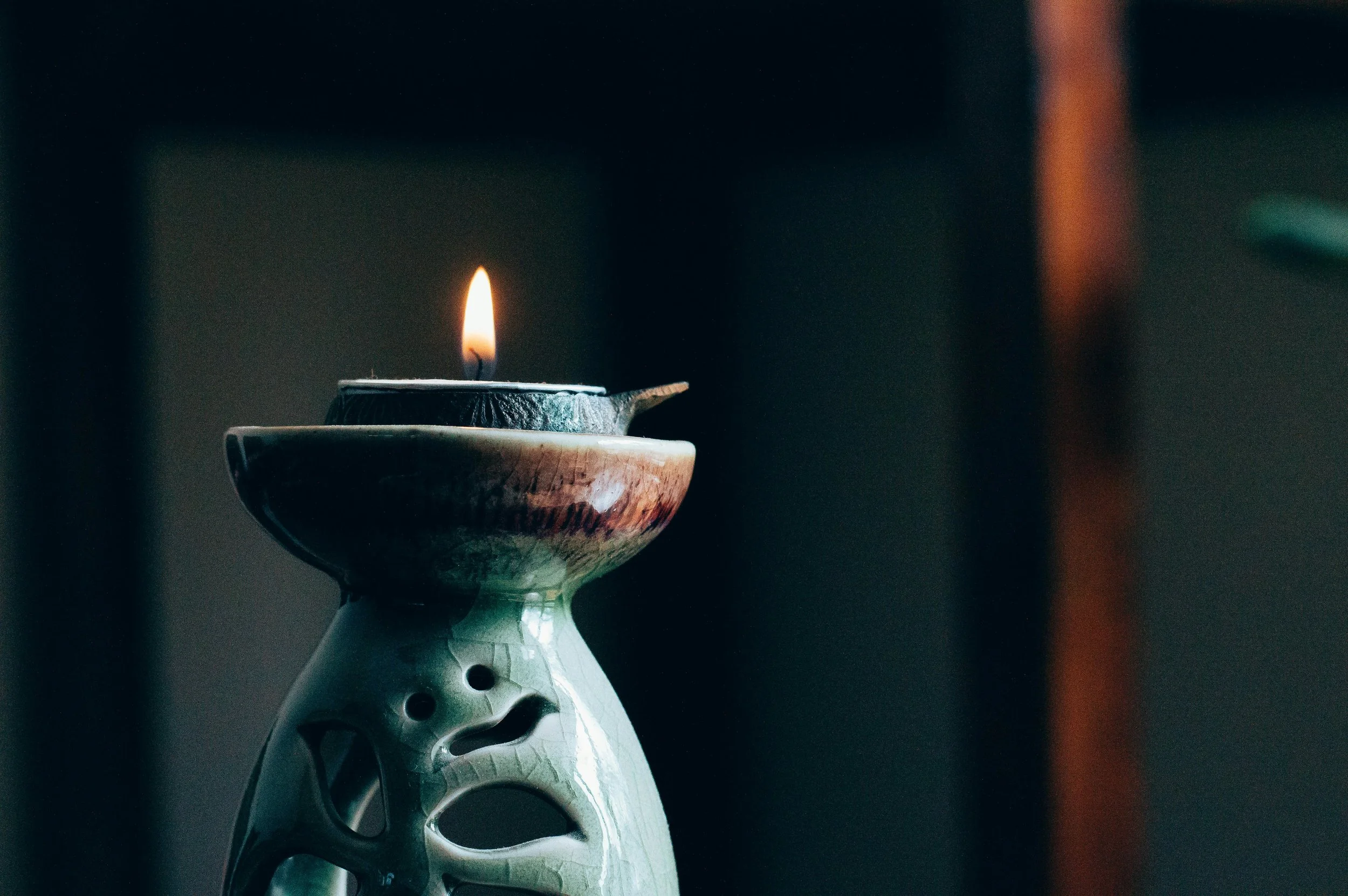
Practice trataka:
Light a candle and place it on a safe and steady surface 2-3 feet in front of you.
Gaze at the tip of the candle flame for as long as comfortable without blinking. Do not strain the eyes; blink as soon as you must.
When you do eventually blink, keep your eyes closed. Gaze at the internal impression left by the candle flame for a minute or two.
If you don’t have a candle, you may choose any object you find comforting, and focus on that instead.
Perform movements from series 1 of pawanmuktasana. If you can, make sure to include all joints (toes, ankles, knees, hips, wrists, elbows, shoulders, and neck). Start with your toes and work your way up to your neck.
Practice 10-15 breaths of marjariasana (Cat Stretch Pose, also known as Cat-Cow). This movement is known to help ease menstrual cramping.
Practice matsya kridasana (Flapping Fish Pose). If you wish, you can hug a bolster or pillow. Remain in this restorative posture for as long as you feel comfortable.
Lie in shavasana (Corpse Pose) for at least 10 minutes. For extra comfort, lie beneath a blanket.
During shavasana, if it feels right, you can try a body scan. Begin by relaxing every muscle in your toes, then feet, then ankles. Move your awareness up your body to your knees, thighs, hips, and so on, relaxing every muscle along the way. Continue all the way up to your head until you are totally relaxed.
Spend at least 10 minutes meditating, either in a seated or lying-down position.
If you like, begin with a few minutes of deep abdominal breathing. Try not to let your chest move; try to breathe with your diaphragm only. Extend your inhalations as long as possible without forcing or straining.
After a few minutes, allow your breathing to return to its natural flow.
If it feels right, you can focus upon ajna (third eye chakra), located at the center point between the eyebrows.
Remain quiet and still for as long as you like. Remember, you are under no obligation at this moment. You needn’t do anything except be here.
When you’re ready, slowly come out of the meditation. Start by wiggling your fingers and toes, then begin to gradually move out of your meditation posture. On the other hand, if it’s naptime and you’re lying down, you can always let yourself fall asleep!
Take care, reader, and much love.
—Amber, Bhujanga Yoga
References
Prana and Pranayama, by Swami Niranjanananda Saraswati
World Yoga Forum — https://worldyogaforum.com/
Brodie, Shopify — https://www.shopify.com/stock-photos/@thenomadbrodie
Matthew Henry, Shopify — https://www.shopify.com/stock-photos/@matthew_henry
Mike Labrum, Unsplash — https://unsplash.com/@labrum777
Aileen David, Unsplash — https://unsplash.com/@aileendavid
Hans Vivek, Unsplash — https://unsplash.com/@oneshotespresso
Topique SL, Unsplash — https://unsplash.com/@topiquesl
Ainur Iman, Unsplash — https://unsplash.com/@mynameisiknow
